
Roleplay
SillyTavern review
Free, open-source roleplay front end you run yourself and connect to any model

Radar score
7.6
/ 10
Desk-researched profile
Pricing model
Free
Starting price
Free (model costs from $0 local to roughly $2–$110 a month via APIs)
Free tier
Yes
Adult content
Allowed
Platforms
Self-hosted (Windows, macOS, Linux, Android via Termux)
Launched
2023
Video generation
No
Voice
Yes
Features:
Chat
Image generation
Voice
Long-term memory
Verdict
The power user’s choice: free, open source and endlessly configurable, with the best memory tools in the directory. You supply the model, the hosting and the patience, and your bill runs from nothing to over $100 a month.
Conversation · 30%
8
/ 10
Memory · 20%
8
/ 10
Media · 20%
5
/ 10
Pricing · 15%
9
/ 10
Policy · 15%
8
/ 10
What works
Free and open source (AGPL-3.0): no account, subscription, adverts or feature locks Connects to local models or dozens of hosted APIs, so you choose quality, privacy and cost Lorebooks, automatic summaries, vector storage and a Data Bank give the strongest memory tooling we list Active project: version 1.19.0 shipped on 14 September 2026 with support for the newest models
What holds it back
Real set-up work: Node.js, Git and a back end to configure; no store app and no iOS install No support desk, no content filter and no age checks; rules are whatever your provider sets Media depends on services you wire up yourself; no video, and a 2026 malicious extension stole users’ API keys
What SillyTavern is
SillyTavern is free, open-source software for chatting and roleplaying with large language models. It describes itself on GitHub as an “LLM Frontend for Power Users”, and that is an accurate summary: it is an interface, not a service. There is no company behind it, no account to create, no subscription and no model of its own. You download it, run it on your own computer, server or Android phone, and point it at a model, either one running locally or a hosted API such as OpenRouter, DeepSeek, Anthropic, OpenAI or Google. The code is licensed under AGPL-3.0, the project started in February 2023 as a fork of TavernAI, and its documentation says it “will always be free and open-sourced”. In October 2026 the repository showed about 34,000 stars and 6,400 forks, and the current release was 1.19.0, published on 14 September 2026. That makes SillyTavern the odd one out in this directory: it is the tool many hosted roleplay platforms are effectively competing against, and its quality depends almost entirely on choices you make.
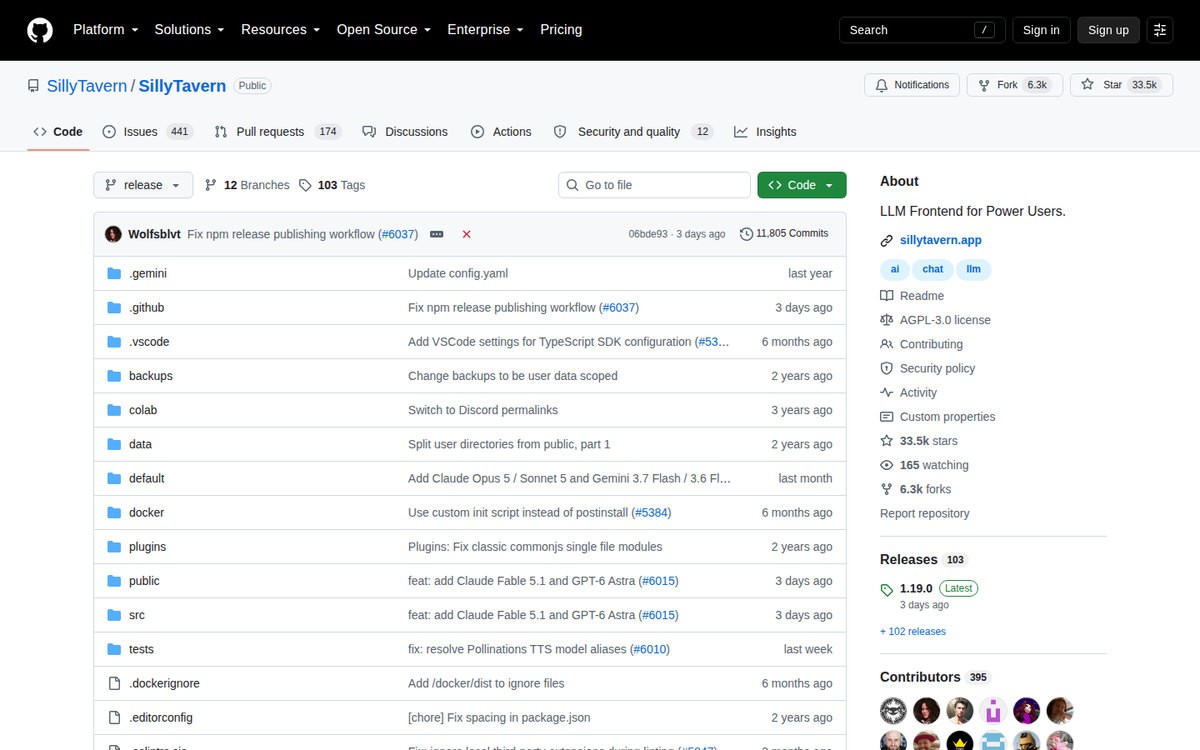
The SillyTavern repository on GitHub, distributed free under the AGPL-3.0 licence, October 2026.
Chat and roleplay
The chat screen is built around character cards: a name, description, personality, scenario, first message and example dialogue, stored as a PNG image with the data embedded. Cards made for other services can be imported, which is why SillyTavern sits at the end of a large community pipeline of card sites. Around the card you set a persona for yourself, an author’s note that is injected near the end of the prompt, and a system prompt or instruct template that controls how the model is addressed. Group chats put several characters in one scene with rules for who speaks next. Swipes let you generate alternative replies and, since version 1.17, a swipe picker lets you browse, branch from and delete them. You can edit any message, continue a reply, impersonate your own side and branch a chat into a new file at any point.
Because there is no platform filter, how a character writes, and what it will write, is decided by the model you connect and the presets you load. With a strong hosted model and a good preset the prose can beat anything in the hosted apps; with a small local model on modest hardware it can be repetitive and forgetful. Community presets on Reddit and Discord do much of the tuning work, and choosing one is most of the learning curve.
Memory
Memory is SillyTavern’s strongest area and the reason its memory sub-score sits near the top of the directory. It offers several tools that work together:
World Info, also called lorebooks: entries that are inserted into the prompt only when a keyword appears, so a large setting or a long relationship history can be kept outside the context until it is needed. Version 1.19 added configurable sorting and made renamed lorebooks keep their links to chats, characters and personas.
Summarize: an extension that periodically condenses the chat so far into a running summary placed in the prompt.
Vector Storage: chat messages are embedded and the most relevant older ones are retrieved by meaning rather than by keyword.
Data Bank: documents and notes attached to a character or chat, retrieved the same way, which the documentation calls built-in RAG support.
None of this is automatic in the way Kindroid or Nomi handle memory. You decide what goes into a lorebook, how often the summary runs and how many tokens each tool may use. The real ceiling is the context window of your model: hosted models in late 2026 commonly accept hundreds of thousands of tokens, while a local model on a 6 to 12 GB graphics card usually works with far less, so the same chat can feel very different depending on the back end. Done well, SillyTavern can hold a months-long story together better than any hosted app; done carelessly, it forgets like any other.
Models and technology
SillyTavern is a Node.js application that runs a small local web server and opens in your browser; it needs Node.js 20 or later since version 1.17. It talks to two kinds of back end. Chat Completion sources include OpenAI, Claude, Google AI Studio and Vertex, Mistral, DeepSeek, OpenRouter, NovelAI, Cohere, Perplexity, Pollinations, NanoGPT, Fireworks, Chutes and any OpenAI-compatible endpoint. Text Completion sources cover local engines such as KoboldCpp, llama.cpp, Ollama, Oobabooga and TabbyAPI, plus AI Horde, a volunteer network that is free but slow when demand is high. Version 1.19 added support for the newest Claude, GPT, Gemini Flash, GLM and DeepSeek models.
The documentation is frank about the trade-off. Paid web services are easy to set up and give the best writing, but they cost money and, in its words, “everything is logged on their server”. Self-hosted models give “total privacy” and cost nothing per message, but need “a GPU with at least 6GB VRAM” and write less well than the state of the art. Sampler settings, reasoning effort, prompt caching and tokenizer choice are all exposed, which is the appeal for enthusiasts and the obstacle for everyone else.
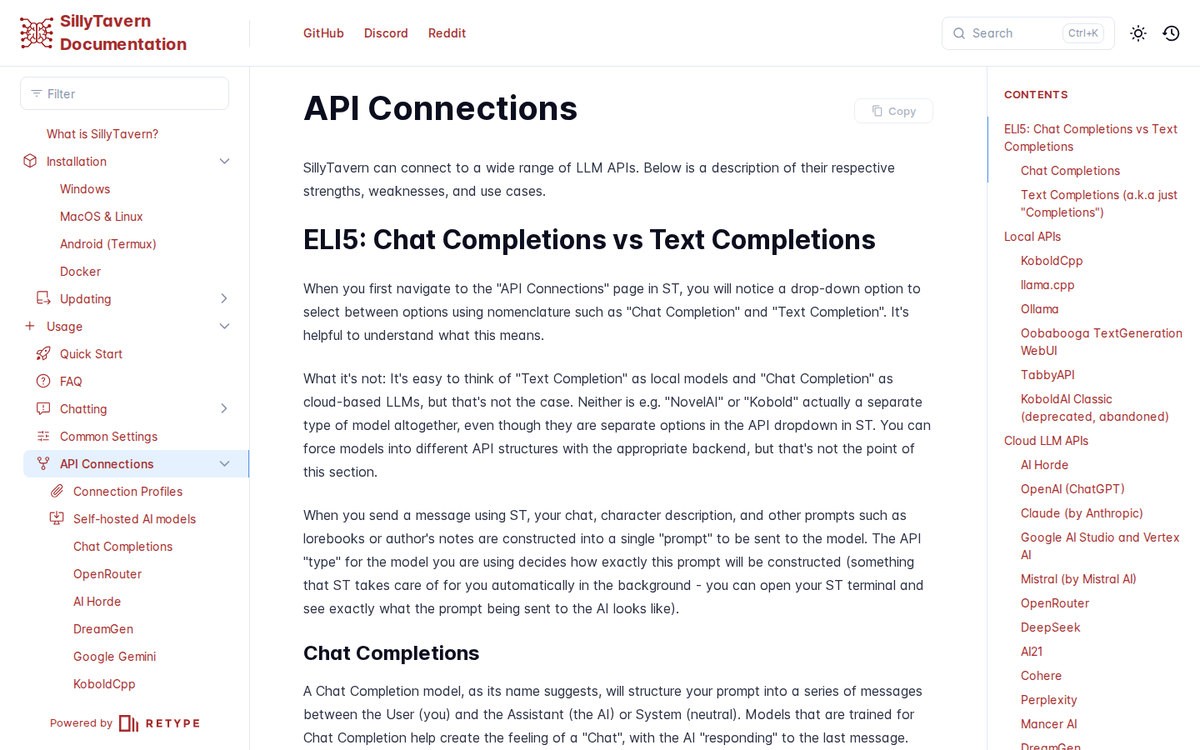
The SillyTavern documentation page listing supported Chat Completion and Text Completion back ends, October 2026.
Images, video and voice
Media comes through extensions that call services you configure. Image generation can use a local Stable Diffusion or ComfyUI install, or hosted APIs such as NovelAI, Pollinations, OpenAI or Black Forest Labs, and can produce a picture of the character or the current scene from the chat. Image captioning lets vision models describe pictures you send. Text-to-speech works with local engines and hosted voices from providers including OpenAI, ElevenLabs and Google, and speech recognition can take your voice as input. Character Expressions swaps a sprite to match the mood of each reply. There is no video generation and no live voice calling in the hosted-app sense, and quality depends on what you connect. That is why media is SillyTavern’s weakest sub-score.
Beyond chat: what else it does
STscript, a built-in scripting language, and Quick Replies, which turn scripts into buttons.
A macro system, rebuilt as Macros 2.0 from version 1.15, for variables and dynamic prompt text.
Web search, translation and tool calling for models that support it.
Multi-user mode with separate, password-protected profiles on one install.
Themes, custom CSS, backgrounds and a large catalogue of third-party extensions.
Third-party extensions run with real access to your install, and that has consequences, as the safety section explains.
The free tier, honestly
The software is completely free, with no paid tier, adverts or feature locks. Whether using it costs anything depends on the model. A local model is free per message once you own suitable hardware. AI Horde is free and volunteer-run. OpenRouter lists a rotating set of free models, limited to 50 requests a day, or 1,000 a day once you have bought at least $10 of credit; Google AI Studio and Mistral also have rate-limited free tiers. Free routes work, but the best roleplay models are paid, and most regular users end up spending something with a provider. The point is that you choose the spend and can see it per message.
Platforms and apps
SillyTavern runs on Windows, macOS and Linux, through Docker, and on Android through Termux, although the project says Termux installs are not officially supported. There is no iOS app and no app in either store; iPhone and iPad users reach an install on another machine through the browser. The Windows guide asks you to install Node.js and Git, clone the release branch into a folder Windows does not protect, and run Start.bat, never as administrator. Using it away from home means a VPN, a tunnel such as Tailscale or a reverse proxy, and the documentation warns in capitals never to put an instance on the open internet without proper security. Any website or app offering “SillyTavern online” is a third party, not the project.
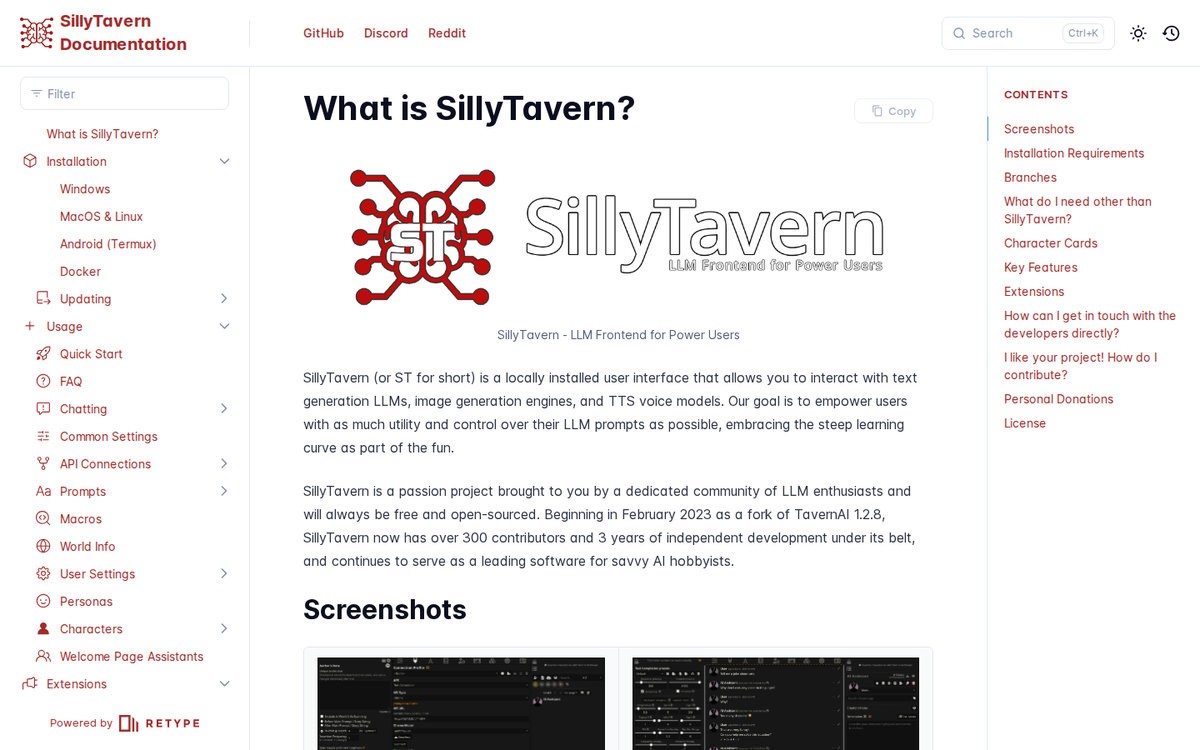
The official SillyTavern documentation home page, which describes it as a locally installed user interface, October 2026.
Support, cancellation and refunds
There is no support desk. Help comes from the documentation, GitHub issues, the official Discord and the r/SillyTavernAI subreddit, where volunteers are active and answers are usually quick. There is nothing to cancel and nothing to refund, because nothing is sold. Any billing, refund or account question belongs to your model provider: OpenRouter credits, a DeepSeek top-up or an Anthropic or OpenAI API account each follow that company’s own terms. Updating is done by pulling the latest release with Git or the bundled updater, and the maintainers ask users to stay current for security reasons.
Who it is for
SillyTavern is for technically comfortable adults who want full control over the model, the memory and the cost of long-form text roleplay, and who are willing to spend an evening installing and tuning it. It rewards people who already know they want a particular model, care where their chats are stored, or want to run everything offline. It is the wrong choice for anyone who wants a phone app with a login, live calls, image and video generation that works out of the box, or someone to email when something breaks. For a hosted experience with strong memory, Kindroid is the closest match; for a large card library without installing anything, Janitor AI and Chub AI are the obvious alternatives.
Research basis: desk research from the official site, help centre, terms and public user reports, October 2026.
Plan | Price | Billing | What it includes | Gated behind credits |
|---|---|---|---|---|
SillyTavern software | Free | None; AGPL-3.0 open source | Every feature: character cards, group chats, lorebooks, summaries, vector storage, extensions, multi-user mode | Nothing; no account or credits exist |
Local model (KoboldCpp, llama.cpp, Ollama) | $0 per message | None; your hardware and electricity | Private, offline chat; the project suggests a GPU with at least 6 GB of VRAM | Limited only by your hardware |
Free hosted routes (AI Horde, OpenRouter free models, Google AI Studio free tier) | $0 | None | Smaller or rate-limited models; OpenRouter free models allow 50 requests a day, or 1,000 after a $10 credit purchase | Daily request limits and queues |
DeepSeek API, direct | Typically $1 to $10 a month | Prepaid balance, per token | DeepSeek Flash at $0.30 per million input tokens and $1.20 per million output at peak, half that off-peak; V4 Pro at $1.32 and $3.96 at peak | Pay per token from your balance |
OpenRouter, premium model (for example Claude Sonnet 5) | Typically $15 to $110 a month | Prepaid credits, per token; 5.5% card fee ($0.80 minimum) | Hundreds of models at the providers’ list prices; Claude Sonnet 5 at $2 per million input and $10 per million output tokens | Pay per token from your credits |
Provider prices were read from DeepSeek’s pricing page and OpenRouter’s public model list in October 2026. Roleplay is expensive in input tokens because the whole character card, lorebook entries, summary and recent chat are resent with every reply.
A worked example: 30 replies a day for a month is about 900 replies. At roughly 8,000 tokens of context in and 350 tokens out per reply, that is about 7.2 million input and 0.3 million output tokens. On DeepSeek Flash at peak rates that comes to about $2.50 a month, less off-peak or with cache hits. The same chat on Claude Sonnet 5 through OpenRouter costs about $18.50 including the card fee. A heavy user at 100 replies a day with 16,000 tokens of context would pay roughly $10 on DeepSeek Flash and around $110 on Sonnet 5, so a long context on a premium model can cost more than any hosted companion subscription.
Safety, privacy and content policy
What the rules allow and ban
SillyTavern has no content policy of its own, because there is no platform to police. What you may generate is governed by your model provider’s terms, which range from strict (OpenAI, Anthropic, Google) to permissive (some OpenRouter providers and local models), and by the law where you live. Hosted providers can and do suspend API keys for breaches.
Age checks
None. The software asks for no account and no date of birth. Any age assurance comes from the provider you pay.
Data and privacy
Chats, characters, settings and API keys (in a local secrets.json file) stay on the machine where SillyTavern runs, and the project offers no hosted service. Data handling therefore depends on the provider you connect: a local model keeps everything on your PC, while a hosted API receives every prompt, and its own policy decides logging, retention and training. OpenRouter says it does no prompt logging by default; direct providers publish their own rules. An instance exposed to the internet without the documented protections is your own security risk.
History
In 2026 a malicious third-party extension, “Bot Browser”, exploited a previously patched flaw in the backup system of versions before 1.17.0 to steal users’ API keys. The maintainers told users to update, rotate keys, remove unofficial extensions and set spending limits. No store removals or regulator action apply.
How to cancel SillyTavern
SillyTavern has no subscription, so there is nothing to cancel with the project itself.
Stop the server and delete the SillyTavern folder; back up the data folder first if you want to keep chats and characters.
Delete or rotate the API keys you saved in it, at each provider’s dashboard.
Cancel any provider plan separately, for example NovelAI, or stop topping up OpenRouter or DeepSeek balances.
Refunds of unused API credit are governed by each provider; prepaid balances are often non-refundable.
Questions people ask
Is SillyTavern free?
Yes. The software is free and open source under AGPL-3.0, with no paid tier. You pay only for the model you connect, which can be nothing with a local model or a free hosted route.
Is SillyTavern safe?
The official release from GitHub is safe to run if you keep it updated, use only trusted extensions and do not expose it to the internet unprotected. Your chats go to whichever model provider you connect, so its privacy policy matters more than SillyTavern’s.
How much does SillyTavern cost per month?
Typically between nothing and about $110. A local model costs nothing per message; moderate use of DeepSeek Flash is a few dollars a month; heavy use of a premium model such as Claude Sonnet 5 through OpenRouter can pass $100.
Does SillyTavern allow NSFW?
SillyTavern itself does not filter anything. Whether explicit content works depends on the model and the provider’s terms; local models and some OpenRouter providers allow it, while major commercial APIs restrict it.
Does SillyTavern have an app?
No. It runs in your browser from a local install on Windows, macOS, Linux or Docker, and on Android through Termux, which is not officially supported. iPhone users connect to an install on another machine.
What is the best model for SillyTavern?
The documentation recommends Claude for creative writing, and many users choose DeepSeek for value. Local models give privacy and zero running cost but need a graphics card with at least 6 GB of VRAM.
How do I cancel SillyTavern?
There is nothing to cancel. Delete the installation folder, and close or empty any API accounts you funded with model providers.
What is SillyTavern’s refund policy?
There is none, because nothing is sold. Refunds for API credits follow each provider’s own terms.
Is SillyTavern down right now?
Live result from our monitor, which loads the public homepage every 15 minutes from a server in Europe. If the site is up but the app misbehaves after login, that is an in-app problem the check cannot see.
Alternatives to SillyTavern

Kindroid
7.4
The most transparent power-user companion: published memory limits, a new Polaris model, explicit content for verified adults. The free tier ends on 1 October 2026; expect a stacked bill and credit meters.

Janitor AI
6.7
The largest free character-chat community, and genuinely free: text only, no images, no video. Memory on the house model is short, and quality dipped in 2026. Janitor+ and the Router fix that for a fee; a proxy fixes it for less.

Chub AI
6.4
The most flexible uncensored roleplay front end short of self-hosting, with shareable character cards and lorebooks. Billing in mandatory four-month blocks and a busy interface hold it back.
Related guides on SillyTavern
Kindroid models explained: Polaris, Ember, Reverie and the tiers
Pick Polaris on Speedy with the Companion flair. Kindroid’s model line from Rhapsody V6 to Polaris, the reasoning slider, context per tier, Lite’s retirement and what Ultra and MAX add.
5 dark horses: underrated AI companion apps in 2026
MyBabes, Kindroid, SillyTavern, Seduced AI and Lovescape score near the top of Radar’s directory with a fraction of the big brands’ fame. Here is why, and the catch with each.
Janitor AI vs MyBabes: free text roleplay or a paid media studio?
Janitor AI wins on price, library size, text depth with a proxy, model choice and apps. MyBabes wins on images, video, built-in memory, stories and games. Category winners and cost maths.