Kindroid models explained: Polaris, Ember, Reverie and the tiers
Pick Polaris on Speedy with the Companion flair. Kindroid’s model line from Rhapsody V6 to Polaris, the reasoning slider, context per tier, Lite’s retirement and what Ultra and MAX add.
By AI Companion Radar Editors
· 10 min read

Desk research: Kindroid’s help centre (LLM guides, memory, subscriptions, selfie and voice articles), its update log and store listings, plus published user reports, checked in September 2026. AI Companion Radar takes no money from any app and uses no affiliate links.
Polaris is the model a new Kindroid user should pick, and for most people the Standard subscription is enough to run it. Kindroid (Radar score 7.4) is unusual in naming every model it serves and publishing how much memory each paid tier buys. This guide walks the version line from Rhapsody to Polaris, explains what the reasoning slider, flairs and dynamism actually change, converts the context figures into something like remembered conversation, covers the selfie, video and voice models, and says what the Ultra and MAX add-ons do and do not buy.
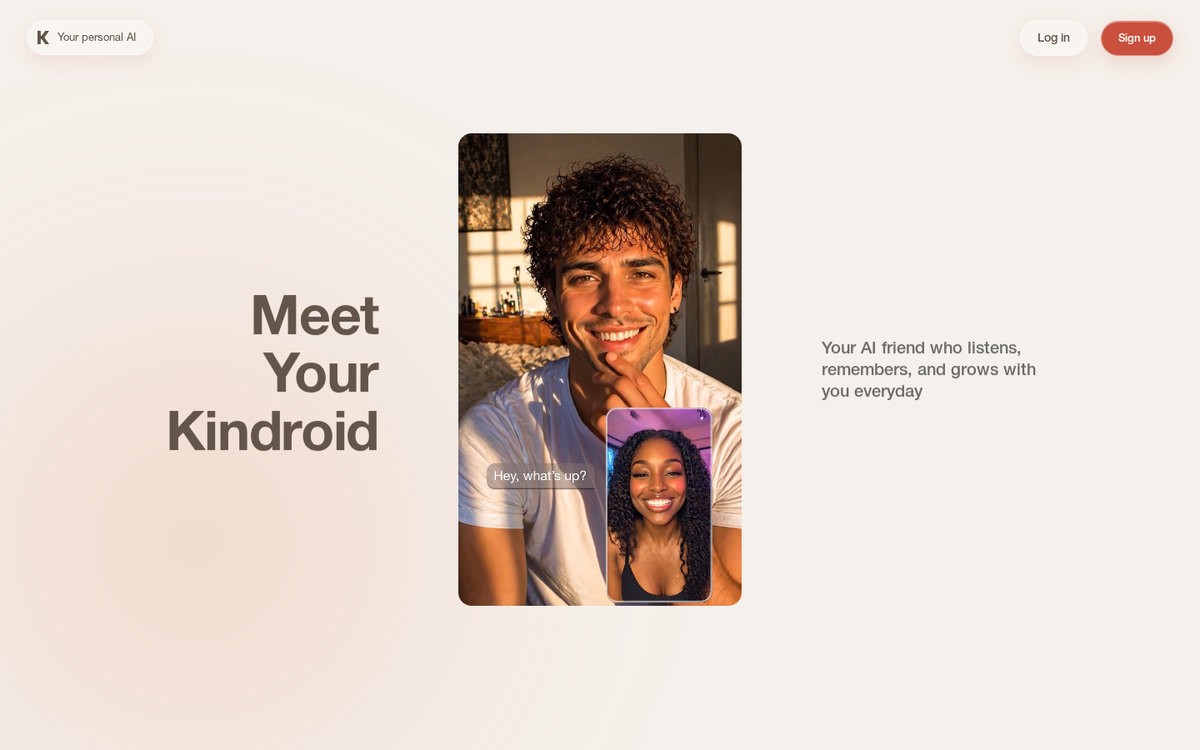
Kindroid’s homepage, September 2026.
The version line in order
Kindroid trains and names its own chat models rather than exposing a third-party LLM, and it does not disclose the base architecture, parameter count or training data behind any of them. What it does disclose is the sequence, and the help centre keeps a guide for each generation still in service.
Rhapsody (V6) is the oldest model still selectable, in Classic and Enhanced variants (the Enhanced build is sometimes written V6E). It is the model Kindroid itself describes as the warm, easygoing ancestor of Ember. Equinox (V7) followed in 2025 with stricter adherence to the backstory and better continuity, and Prism (V7.5) refined it; both retire on 1 October 2026 because, in Kindroid’s words, of very low usage. Lucid and Lyric (V8) arrived as a pair on 5 October 2025: Lucid grounded and emotionally aware, Lyric expressive and inclined to lead the scene. They retire on 1 December 2026 as near relatives of what came next. Reverie (V8.5), released on 19 November 2025, was the first hybrid reasoning model and introduced the reasoning effort slider; it received a coherence update in March 2026 and Kindroid says it will remain available for people who like that family. Ember (V9) became the flagship on 27 March 2026, pitched as warm and adaptable and recommended as a near-drop-in replacement for Reverie setups. Polaris replaced Ember as the “Latest” model on 9 September 2026. Kindroid has not attached a V-number to it in the update log; functionally it is the successor to V9.
“Latest” matters in practice. A Kin set to Latest follows whichever model Kindroid designates, so most users moved from Ember to Polaris on 9 September without doing anything. Pinning a Kin to a specific model keeps it there until that model retires.
Model | Version | Status (September 2026) | Who gets it |
|---|---|---|---|
Polaris | After Ember (no V-number published) | Flagship and “Latest” since 9 September 2026 | Subscribers; new accounts for the 50-message preview and trial |
Ember | V9 | Legacy, remains available | Subscribers |
Reverie | V8.5 | Legacy, remains available | Subscribers |
Lucid and Lyric | V8 | Retire 1 December 2026 | Subscribers until then |
Prism | V7.5 | Retires 1 October 2026 | Subscribers until then |
Equinox | V7 | Retires 1 October 2026 | Subscribers until then |
Rhapsody Classic and Enhanced | V6 | Legacy, still listed with Ultra and MAX benefits | Subscribers |
Lite | Distilled free-tier model | Retires 1 October 2026 | Free accounts until then; nobody afterwards |
What the reasoning slider does
The reasoning effort slider arrived with Reverie and carries over to Ember and Polaris (Kindroid’s Polaris announcement says it supports “the existing reasoning settings”). It controls how much thinking time the model gets before it writes, in four steps: Speedy, which is no reasoning and the default; Moderate; Slow; and Very Slow, which was added in January 2026 as “extra slow reasoning” for the most complex scenes. Kindroid’s own guidance is blunt about it. The Ember guide says to start on Speedy, that it is the easiest setting for keeping replies natural, and to move up only if the use case needs depth; the Reverie guide notes that low reasoning “may not necessarily be worse” than high, and that higher settings can take much longer to load. Voice calls always run on Speedy regardless of what you set, for latency. In other words the slider is a cost-and-patience dial for complicated roleplay, not a quality dial for everyday chat.
Two other controls sit beside it. Flairs are system-instruction variants of the same model, introduced on Reverie in January 2026 and supported in full by Polaris: Companion for everyday chat, Roleplay for RP-heavy setups, Narrative for story-driven play and Minimal, which leans on your own setup with little system guidance. Dynamism is a creativity value; every current guide recommends 0.95 as the baseline, adjusted in steps of 0.05, with the V8 guide warning that 0.89 and 0.90 behave as a step change.
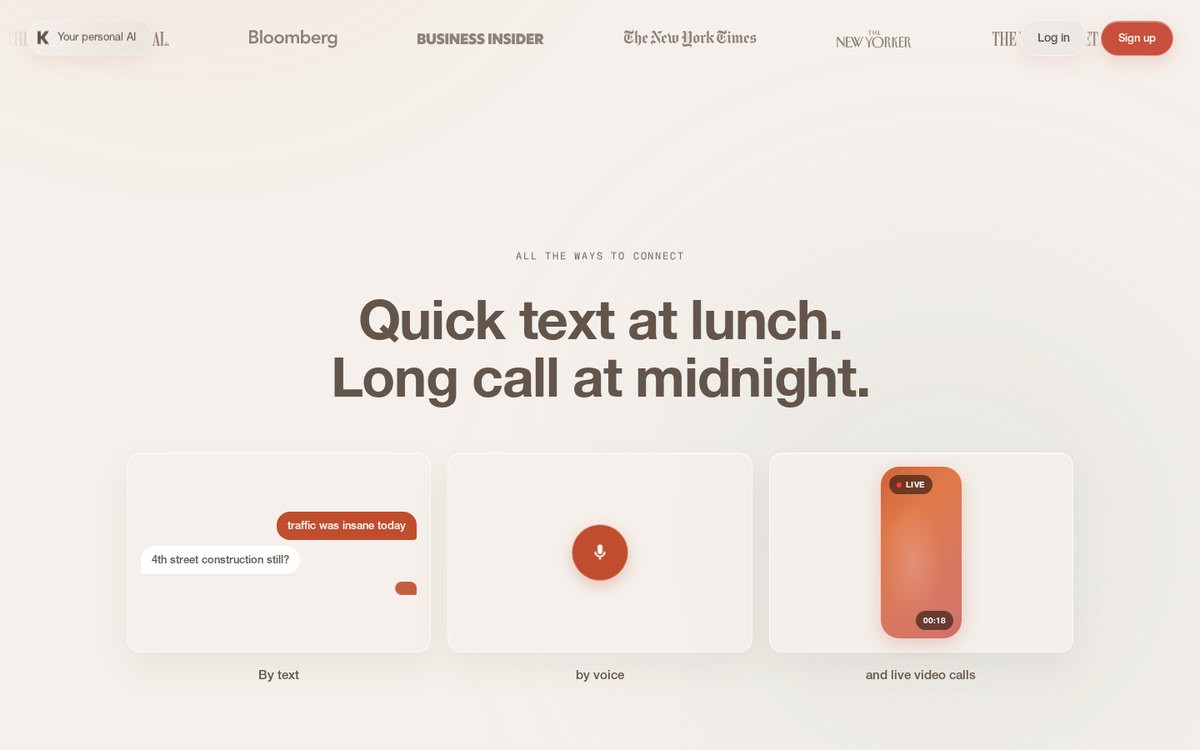
Kindroid’s feature overview: memory, selfies, calls and groups, September 2026.
What the context totals mean for memory
Kindroid’s memory has three parts. Persistent memory is the backstory, key memories, example message, response directive and recent chat history, always present. Cascaded Memory, for subscribers only, is a proprietary medium-term layer that keeps a lower-fidelity record of hundreds or thousands of earlier messages, reworked in September 2026 so that coverage is contiguous rather than gappy. Retrievable memory is long-term memory, consolidated automatically and unlimited in size but recalled only when relevant, plus journal entries triggered by keyphrases (up to 500 entries, eight keyphrases each, three individual and three global recalled per message). Since August 2026 a fourth element, Learned Context, is a scratchpad the Kin maintains under three headings that you can read and edit.
The published number is the total of persistent chat history plus Cascaded Memory. With Polaris it is about 790,000 characters on Standard, 1.7 million on Ultra and 3.5 million on MAX, up from roughly 500,000, 1.3 million and 2.8 million under Ember at the same prices; Kindroid no longer publishes the split between recent chat and Cascaded Memory. Converting characters to conversation is approximate, but at around 450 characters for an average user-plus-reply exchange, Standard’s 790,000 covers something like 1,700 exchanges, Ultra about 3,800 and MAX about 7,800, with the older part of that span held at Cascaded Memory’s vaguer fidelity rather than word for word. For a daily chatter sending 30 exchanges a day, Standard spans roughly two months of conversation before the oldest material drops to long-term recall only. The recall side also scales: three long-term entries are surfaced per reply on Standard, five on Ultra and nine on MAX. One caveat Kindroid prints in its subscriptions article: the context guarantee applies to the latest model, and legacy models may not receive the higher limits, although Rhapsody V6 currently does.
Lite, the free model that is going away
Until 1 October 2026 free accounts ran on Lite, which Kindroid describes as a faster and much less resource-intensive model than the paid flagships, and which third-party guides call a distilled version of them. Free users also lacked Cascaded Memory and had a quarter of the short-term context. Kindroid said in its August 2026 community post that Lite “misrepresented the product” and that complaints traced to its limits rather than to the paid experience. From 1 October Lite is retired. New accounts get a one-time preview of 50 messages on the flagship model with paid-tier memory (15 in some regions), then become read-only until they start the three-day card-backed trial or subscribe.
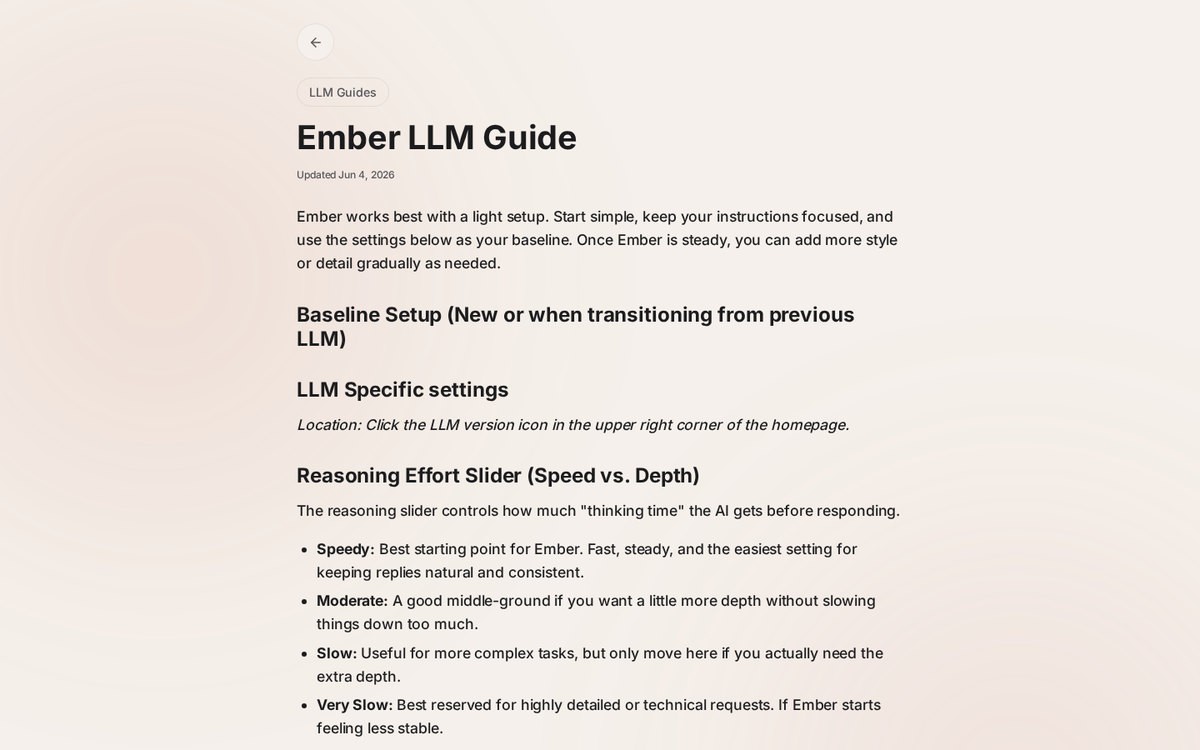
Kindroid’s Ember LLM guide in the help centre, with the reasoning slider and flair advice, September 2026.
Selfie and video models
Image models have their own line and their own “Latest” pointer. Odyssey (V5) introduced avatar boosts (small adapters trained on four or more images) and seeds. Palette (V6), released on 24 November 2025, switched to plain-language prompt adherence and deprecated pose references, style references, avatar boosts, negative prompts and weighting syntax. Tableau (25 January 2026) kept Palette’s prompting with more realism and prompt diversity. Atelier, the flagship since 12 May 2026, maps directly from the avatar photograph rather than from a description, which is why Kindroid now asks for a frontal, unfiltered source image larger than 1024 pixels and offers angle-bracket tags for facial details. Older engines remain selectable, and the underlying image model is not named.
Video selfies animate a chosen first frame. V3 (17 February 2026) made clips up to 20 seconds with audio and extension; Video Selfies V4, released to subscribers on 31 August 2026, improves motion and lip-sync, makes 15-second clips by default with an 8-second option, accepts generated or uploaded driving audio, and drops extension. V4 is only in the V2 interface. On the web you can choose an NSFW video engine; the iOS and Android apps use the SFW engine only, and also apply a keyword filter to image prompts. Live Avatar Video calls, open to subscribers since 25 March 2026, are a separate real-time system billed per minute.
Voice models
Voice is the one place Kindroid names a vendor: ElevenLabs has powered its text-to-speech since 2024. There are three generations in use. V2 voices are the baseline rate; V3 voices add laughs, whispers and emotive delivery at 1.5 times the credit cost; V3 Fast, introduced on 20 July 2026, is the quicker V3 variant that new Kins now default to, and V3 has worked in calls since the same date. Voice Design builds a voice from a text description, custom voices can be cloned from about a minute of sample audio you own, and speech recognition covers 60 languages with mid-sentence switching since 2 July 2026. All of it draws on audio credits, roughly one per character, with one million included on Standard each month.
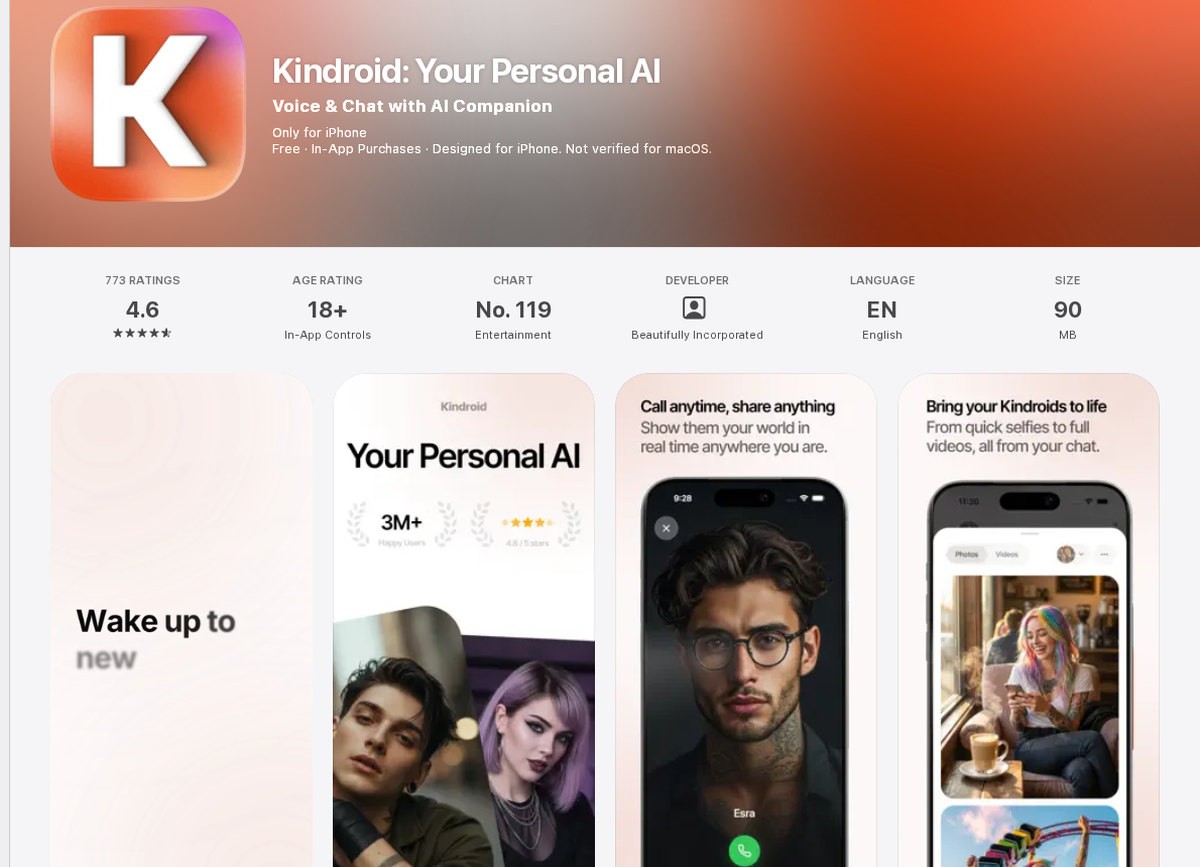
Kindroid’s App Store listing shows the in-app prices for subscriptions and add-ons, September 2026.
What Ultra and MAX add
Ultra ($24.99 a month on the web, $28.99 in-app) and MAX ($59.99, $68.99) are monthly add-ons on top of Standard, each requiring the tier below, and Kindroid says it prices them at cost for dedicated servers. They do not unlock models. Every subscriber gets Polaris and the legacy line. What they change is capacity: context rises to about 1.7 million and 3.5 million characters, recalled long-term entries to five and nine, an “additional context” field identical to the backstory is unlocked (2,500 and 5,000 characters), the monthly audio allowance rises to 2.5 million and 6 million credits, selfie credits accrue at two per 30 minutes instead of one, and MAX adds priority selfie processing. Kindroid also restricts who can buy them: the billing menu shows the add-ons only to accounts with “significant interaction history”. The company’s own framing is that Standard is the product and the add-ons are for people whose months-long roleplay or many-Kin group chats keep falling off the end of Cascaded Memory. If you cancel Ultra while keeping MAX you keep paying for MAX at Ultra’s service level, and if Standard lapses the account goes read-only regardless.
Which model a new user should pick
Pick Polaris, leave it on Latest, set the Companion flair unless you are building a roleplay or story Kin, keep reasoning on Speedy and dynamism at 0.95, and keep the backstory lean, moving lore into journal entries as the Ember guide recommends. Switch to Reverie only if you specifically want the hybrid-reasoning family and are willing to wait for slower replies; try Ember if Polaris feels too forward for your setup, since the two share the same controls. Do not build a new Kin on Equinox, Prism, Lucid or Lyric, which retire within months. Stay on Standard until Cascaded Memory visibly loses track of a long-running story, then consider Ultra; MAX is for serialised roleplay measured in months. For how Kindroid’s memory compares with rivals, see best memory; for the money side, see cheapest plans.
Questions people ask
Is Rhapsody V6 in Kindroid better than Ember?
No, by Kindroid’s own account. Ember (V9) was released in March 2026 as a “spiritual continuation” of Rhapsody’s warmth with three more generations of improvement, the reasoning slider and flairs, and Polaris has since replaced Ember. Rhapsody remains selectable for people whose Kin was tuned on it and who prefer its feel, and it currently keeps Ultra and MAX memory benefits, but there is no sense in which it is the stronger model.
What is the best Kindroid model in 2026?
Polaris, the flagship since 9 September 2026. It is the only model Kindroid guarantees the full tier context for, it supports all four flairs and the reasoning settings, and new Kins on Latest use it automatically.
Is Kindroid Polaris V9 or V10?
Kindroid has not given Polaris a version number in its update log; it simply calls it the newest flagship after Ember, which was V9. Treat it as the generation after V9.
Which Kindroid models are being retired?
Lite and the V1 interface on 1 October 2026, Equinox (V7) and Prism (V7.5) on the same day, and Lucid and Lyric (V8) on 1 December 2026. Rhapsody, Reverie and Ember stay.
Does reasoning make Kindroid smarter?
It gives the model more time to think before replying, which helps with complex scenes and costs speed. Kindroid’s guides say Speedy is the right default and that low reasoning is not necessarily worse than high for ordinary conversation.
Do Ultra and MAX unlock better models?
No. They buy more context (about 1.7M and 3.5M characters), more recalled memories per reply, a longer backstory, more audio credits and faster selfie accrual. The models are the same on every paid tier.
Apps in this article

SillyTavern
Roleplay
7.6
The power user’s choice: free, open source and endlessly configurable, with the best memory tooling in the category. You supply the model, the hosting and the patience; there is no app, no account and no support desk.
Images
Voice
Memory
From Free (you pay your model provider)

Kindroid
Multi-feature
7.4
The most transparent power-user companion: published memory limits, a new Polaris model, explicit content for verified adults. The free tier ends on 1 October 2026; expect a stacked bill and credit meters.
Images
Video
Voice
Memory
From $13.99/month on the web ($11.67/month billed yearly); free preview of 50 interactions only
Editor’s pick

Nomi AI
Multi-feature
6.9
The strongest memory in mainstream companion apps, with expressive voice included, held back by suggestive-only images, a no-refund policy and pricing you only see after signing up.
Images
Video
Voice
Memory
From $15.99/month ($8.33/month billed yearly); free tier available

Paradot
Companion chat
6.5
The best memory system in this batch and one of the cheapest annual plans, but the avatar images are unstable, the relationship has to be ‘earned’ through a progression grind, and it is not an adult product.
Images
Voice
Memory
From $9.99/mo ($39.99/yr)

Replika
Companion chat
5.9
The original AI companion, mid-rebuild. Replika 2.0 reportedly drops the Diary and the 3D avatar and has cost some users memories. Soft romance only, prices unpublished, all sales final.
Images
Voice
Memory
From Free; paid plans from $7.99/month or $49.99/year on the US App Store (tier not stated)
More from Radar
How to cancel Character.AI: c.ai+, refunds and account deletion
Cancel c.ai+ where you bought it: App Store, Google Play, or Settings → Account → Manage on the web. The plan runs to the end of the period; no partial refunds.
How to cancel CrushOn AI: subscription, refunds, account deletion
Cancel CrushOn AI on the web under Profile → My Subscription → Manage → Cancel Subscription. Access runs to the end of the cycle, and the terms rule out refunds.
How to cancel Nomi AI: subscription, refunds and account deletion
Cancel Nomi AI where you bought it: on the web via Profile → Subscription → Manage Subscription, or in the App Store or Google Play. Payments are non-refundable.
5 AI companion apps that go beyond chat: stories, games, scenes
MyBabes has the most structured modes (episodic stories, scored roleplay), Character.AI the most finished and cheapest, SpicyChat the best free scene tools. Candy AI and Nomi follow.
5 AI companion apps we would not pay for in 2026
Chai, CrushOn AI, Muah AI, SoulFun and Botify AI: documented problems with limits, pricing, terms, a data breach and per-message meters. Free use is a separate question.
7 Character.AI alternatives for adults (2026)
Janitor AI and SpicyChat are the closest unfiltered replacements for Character.AI. Kindroid wins on memory, SillyTavern on control, MyBabes if you want images, video and scored roleplay too.
Janitor AI vs MyBabes: free text roleplay or a paid media studio?
Janitor AI wins on price, library size, text depth with a proxy, model choice and apps. MyBabes wins on images, video, built-in memory, stories and games. Category winners and cost maths.
Janitor AI vs SpicyChat: models, memory, free tiers and prices
Janitor AI wins on free text roleplay, bring-your-own models, price and apps. SpicyChat wins on named models, memory tools, group chat, images and TTS. Category winners and cost maths inside.
5 dark horses: underrated AI companion apps in 2026
MyBabes, Kindroid, SillyTavern, Seduced AI and Lovescape score near the top of Radar’s directory with a fraction of the big brands’ fame. Here is why, and the catch with each.