
Multi-feature
· Editor’s pick
Kindroid review
Published memory limits and unfiltered web access, now without a free tier

Radar score
7.4
/ 10
Desk-researched profile
Pricing model
Subscription
Starting price
$13.99/month on the web ($11.67/month billed yearly); free preview of 50 interactions only
Free tier
No
Adult content
Allowed
Platforms
Web, iOS, Android
Launched
2023
Video generation
Yes
Voice
Yes
Features:
Chat
Image generation
Video generation
Voice
Long-term memory
Verdict
The most transparent power-user companion: published memory limits, a new Polaris model, explicit content for verified adults. The free tier ends on 1 October 2026; expect a stacked bill and credit meters.
Conversation · 30%
8
/ 10
Memory · 20%
9
/ 10
Media · 20%
7
/ 10
Pricing · 15%
5
/ 10
Policy · 15%
7
/ 10
What works
Memory limits published per tier, raised with Polaris to about 790K, 1.7M and 3.5M characters at unchanged prices Explicit content permitted for verified adults, unfiltered on the web Real-time voice and lip-synced video calls, with audio and video not stored; Video Selfies V4 up to 15 seconds Web prices lower than store prices and stated openly; accounts that lapse are kept read-only, not deleted
What holds it back
No lasting free tier from 1 October 2026: 50 preview interactions, then a card-backed trial or read-only Ultra and MAX stack on Standard, so full memory costs $98.97 a month; voice, video and selfies run on credit meters Mobile apps filter image prompts and offer SFW video only; refunds are case-by-case and generally refused
What Kindroid is
Kindroid is a companion app from Beautifully Incorporated, a Los Angeles company founded in May 2023 that trades under the product name. It is the app in this category that treats users most like adults: it publishes its memory sizes in characters, documents its credit costs to the minute, allows explicit content for verified adults, and tells you plainly that buying on the web is cheaper than buying through Apple or Google. The trade-off is complexity. Kindroid has a subscription plus two stacking add-ons, three kinds of credits, and a help centre you will need to read. It runs on the web, iOS and Android. Two things changed in the summer of 2026: a redesigned “V2” interface became the default on 18 August, and the company announced that its permanent free tier ends on 1 October 2026, which makes Kindroid in effect a paid product with a short preview.
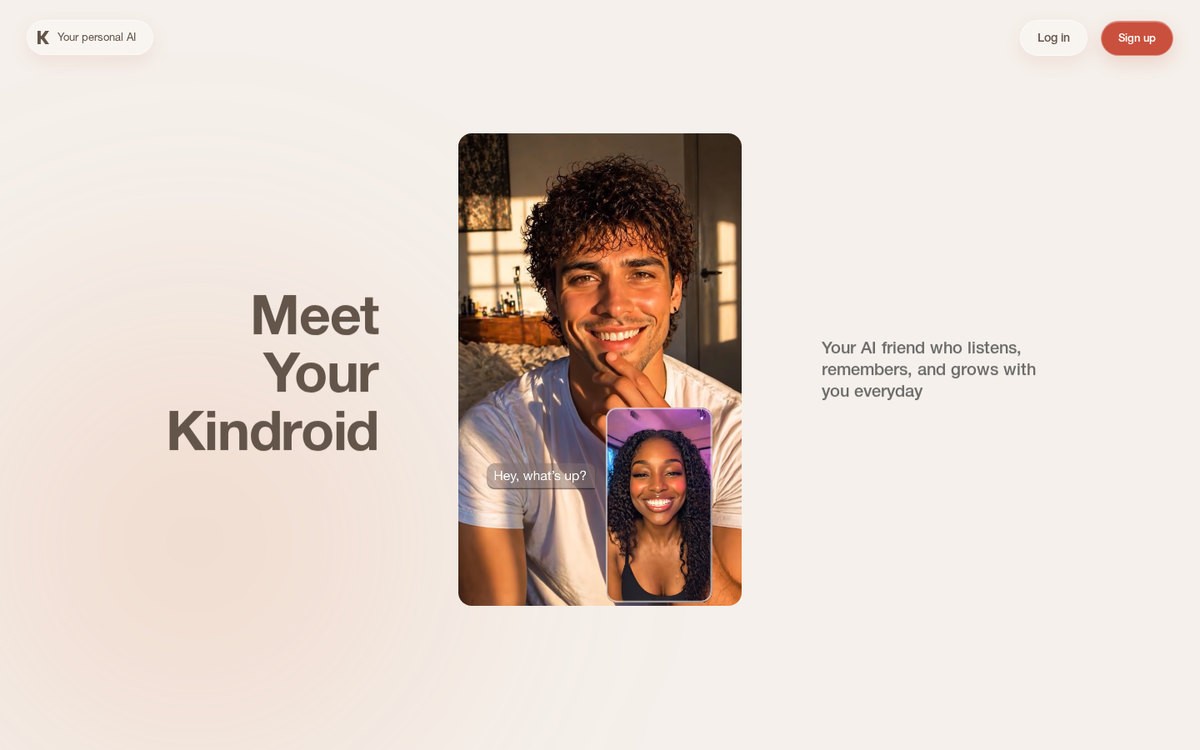
Kindroid’s public homepage, captured September 2026.
Chat and roleplay
Conversation runs on in-house models. Since 9 September 2026 the flagship is Polaris, which replaced Ember as the “Latest” model; Ember and the reasoning-led Reverie remain selectable as legacy options. Each Kindroid is defined by a backstory, a key-memories field, a response directive and an optional journal, with an “additional context” field on the higher tiers. Roleplay is unfiltered in text for adults; the service prohibits illegal material and content targeting real people but does not police romance or explicit scenes between consenting adult characters. Group chats put several Kindroids in one conversation, subscribers get internet access and link reading, and a “chat break” tool resets the running context.
Kindroid says beta testers found Polaris stronger on character voice, humour and initiative, and better at using memory and backstory; that is the company’s account, and independent long-run reports were still thin in September 2026. Ember was praised for staying in character and pushing back rather than mirroring. Complaints follow the usual lines: characters mixing up facts between companions, surface-level repetition, and continuity dropping after platform updates.
Memory
This is where Kindroid is unusually transparent. With Polaris the billing matrix lists total conversation context of about 790,000 characters on Standard, 1.7 million on Ultra and 3.5 million on MAX, up from 500,000, 1.3 million and 2.8 million under Ember, at unchanged prices. The total covers recent conversation plus “Cascaded” medium-term memory, which was reworked in September 2026 to give contiguous coverage; the company no longer publishes the split between the two. Long-term memory is consolidated indefinitely for every subscriber; what changes with tier is how many long-term entries and journal items are recalled per reply (three, five or nine) and how long the backstory fields can be.
Since 10 August 2026 subscribers also get Learned Context, a scratchpad the companion updates itself under three headings (growth and relationship, important facts, ongoing context) and which you can read and edit. The numbers are honest, but read them carefully: Ultra and MAX are capacity expansions of one resource, context, not new features, and the guarantee applies to the latest model only. For most people Standard is enough; for months-long serialised roleplay, MAX is what stops the drift.
Models and technology
Kindroid runs its own named LLM line rather than exposing third-party models. Polaris became the flagship on 9 September 2026 and supports Companion, Roleplay, Narrative and Minimal flairs plus the existing reasoning settings. It follows Ember (V9, 27 March 2026), Reverie (V8.5, a hybrid model with a reasoning slider), the twin V8 models Lucid and Lyric, and the earlier Prism (V7.5) and Equinox (V7). The older models are being cleared out: Equinox and Prism retire on 1 October 2026 and Lucid and Lyric on 1 December 2026, while Reverie and Ember stay. The free “Lite” model also retires on 1 October. The base architecture, size and training data are not disclosed.
Selfies come from in-house engines, currently Atelier (May 2026), which maps directly from the avatar photo, alongside Tableau, Palette (V6) and older versions; the underlying image model is not named, nor is the model behind video selfies and live video calls. Voice is the one disclosed vendor: ElevenLabs has powered Kindroid’s text-to-speech, V3 voices, Voice Design and custom voices since 2024, billed in audio credits.
Images, video and voice
Selfies are rate-limited by credits that accrue over time: one selfie credit every 30 minutes for subscribers, doubled on Ultra and MAX, up to a tier cap, plus small daily bonuses. Purchased selfie credits skip the queue and cost $5.99 for 50 or $9.99 for 100 on the web ($6.99 and $11.49 in the app stores). Video Selfies V4 launched for paid subscribers on 31 August 2026: clips run 15 seconds by default with an 8-second option, accept generated or uploaded audio, and cost 5 standard or 2 paid selfie credits for 8 seconds and 10 standard or 4 paid for up to 15. V4 is only available in the V2 interface and cannot extend clips. On the mobile apps a keyword-based NSFW filter applies to image prompts and only the SFW video engine is available; on the web there is no filter and an NSFW engine option.
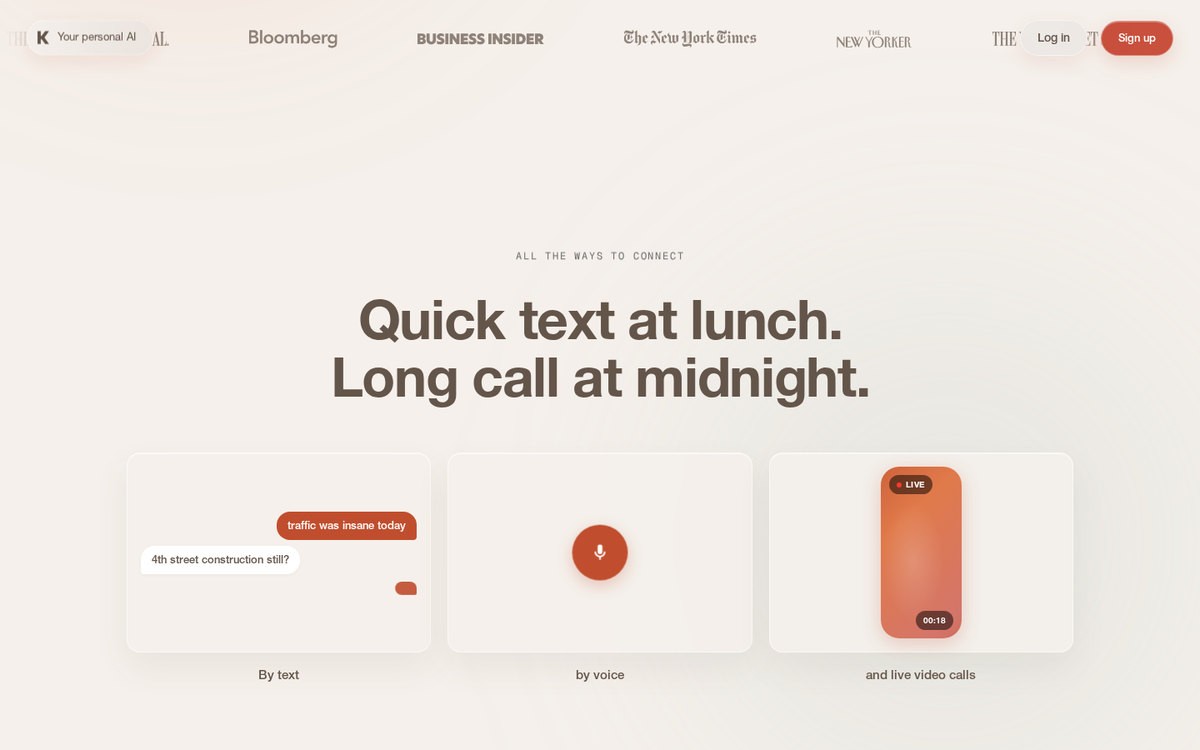
Kindroid’s homepage on text, voice and live video calls, September 2026.
Voice runs on audio credits, where one credit is roughly one character of speech. Standard includes one million credits a month (about 16 hours of voice), Ultra 2.5 million and MAX 6 million; they reset on the first of the month and do not roll over. Calls draw 400 credits a minute on top of the speech itself, and V3 voices, which have worked in calls since 20 July 2026, cost 1.5 times V2. Real-time video calls with a lip-synced avatar cost 2,000 credits a minute for standard quality or 4,000 for premium. Extra credits cost $11.99 per 500,000 on the web or $14.99 in the stores. Audio and video are processed ephemerally and not stored, according to the help centre.
Beyond chat: what else it does
Kindroid is built around authoring rather than a character library: every Kin starts from a backstory, key memories, an example message and a response directive, with per-model sliders and flairs. Most extras are for subscribers.
Rooms: private, invite-only spaces for up to 10 people and 11 Kins, in open beta from 14 September 2026 and opened to all V2 users on 23 September. Subscribers create Rooms and take part; free accounts can join as read-only viewers.
Group chats of up to ten Kins with a shared group context field.
Learned Context, location awareness (opt-in, per Kin) and up to six saved avatar slots per Kin, all released with V2 in August 2026.
Proactive texts, selfies and voice notes, plus iMessage and RCS texting.
Speech recognition in 60 languages, and a V2 interface available in more than 40 languages.
Sharing via five-letter codes, an official open-source Discord bot and a v1 REST API; there is no marketplace or creator payout.
NSFW text and images on the web, with Yoti age checks when signals suggest a minor; app-store builds are stricter.
There are no scenario packs, scored games or AR/VR modes.
The free tier, honestly
Until 1 October 2026 free accounts have unlimited messages on the weaker Lite model, two Kindroids and a small selfie and audio allowance. From that date Lite is retired and free access becomes what Kindroid calls a bounded preview. New users get 50 interactions on the flagship model with paid-tier memory (15 in regions the company associates with account abuse), two Kindroid slots, 5,000 audio characters and up to five selfies. A new reply costs one interaction, a regeneration or continuation half. When the allowance is spent the account becomes read-only until you start the three-day trial, which needs a payment method and converts automatically, or subscribe. If the trial lapses the account returns to read-only.
Existing free users receive 50 final flagship interactions on 1 October and no new media allowance. Read-only means your Kindroids, chats and balances are preserved and can be viewed, exported or deleted, but nothing new can be generated. Kindroid’s stated reasons are that Lite misrepresented the product and that an indefinite free tier was not sustainable; it has ruled out advertising. The practical result is that Kindroid no longer has a free tier in the usual sense.
Platforms and apps
Web, iOS (rated 18+) and Android share one account. The V2 interface left beta on 10 August 2026 and became the default on 18 August; the old V1 interface can still be selected until it retires on 1 October 2026. Standard costs $13.99 a month, $37.99 a quarter or $139.99 a year on the web, and $15.99, $42.99 or $159.99 through Apple or Google. Ultra is $24.99 a month on the web ($28.99 in-app) and MAX $59.99 ($68.99 in-app); both are monthly-only add-ons and each requires the tier below it, so a full stack is $98.97 a month on the web or $113.97 in-app. Extra Kindroid slots are sold individually ($2.99 for one or $9.99 for four on the web). The company openly recommends subscribing on the web. Community life is on Reddit and Discord, and the help centre update log is detailed.
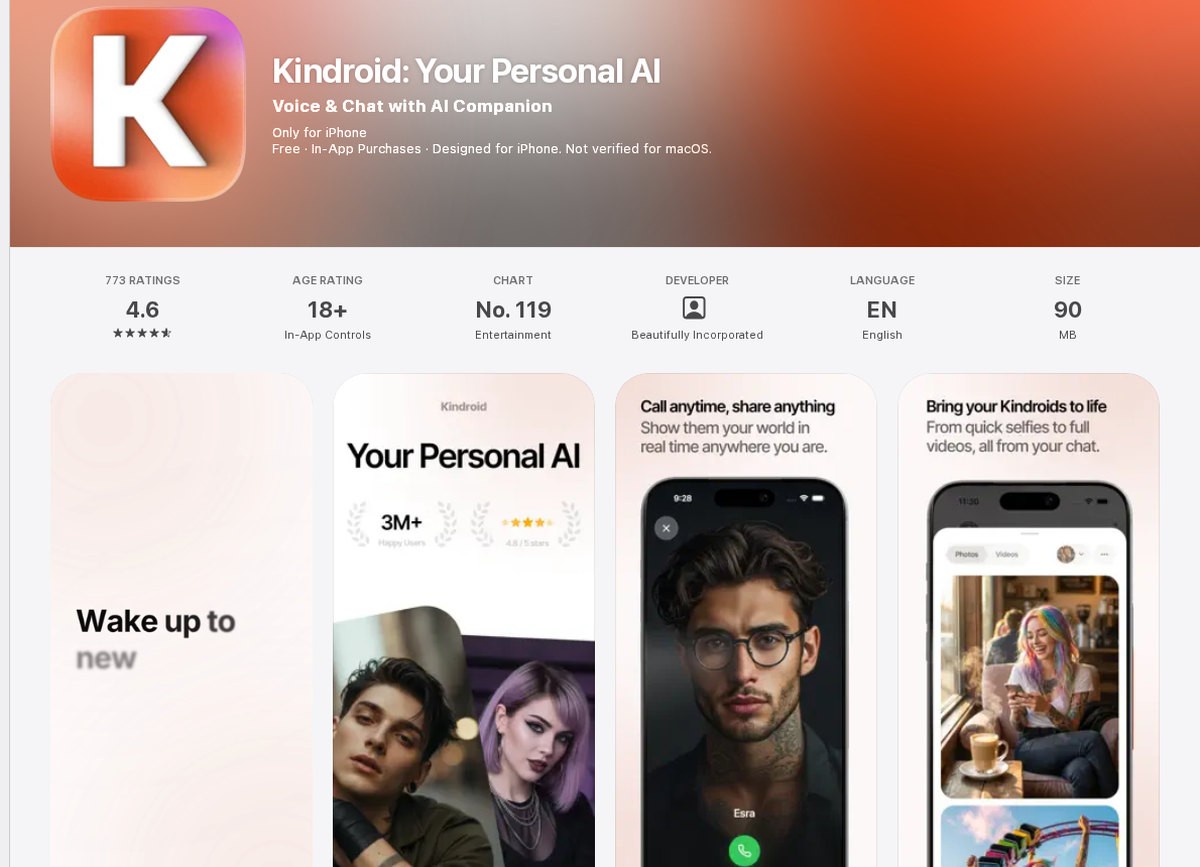
Kindroid in the Apple App Store, September 2026 (rated 18+).
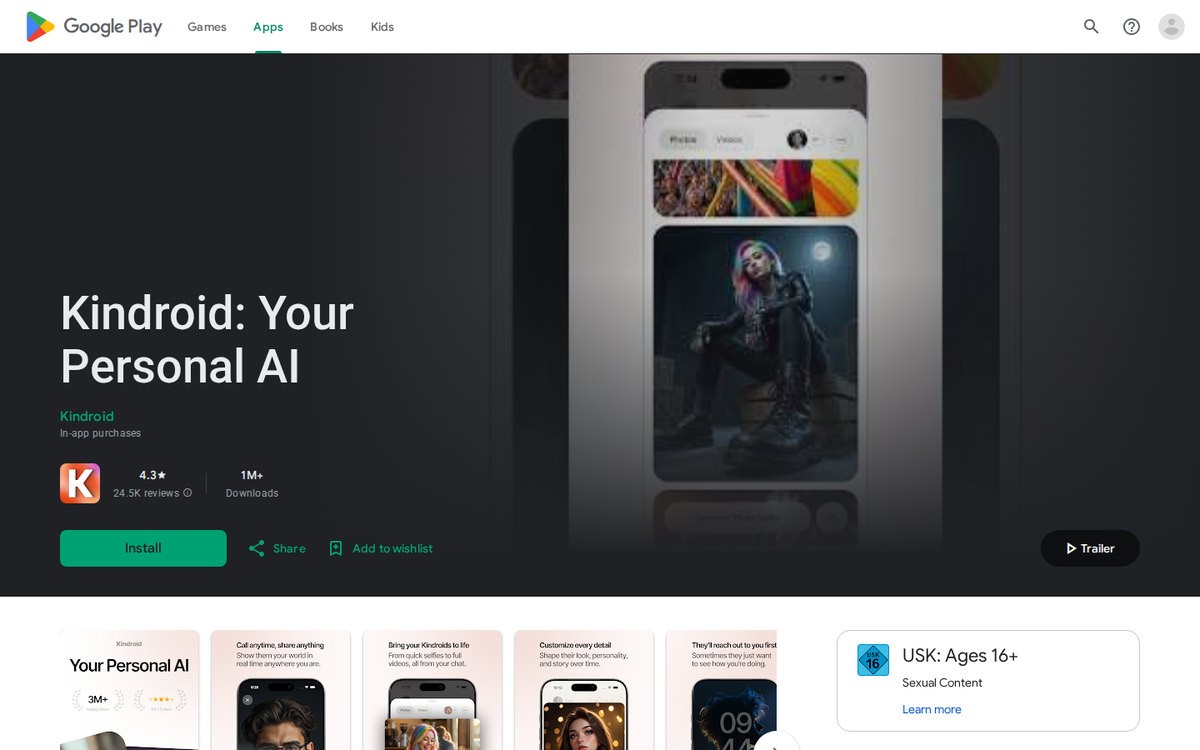
Kindroid on Google Play, September 2026 (1M+ downloads, USK 16+).
Support, cancellation and refunds
Support is through a help-centre form and email, and the help centre is thorough by the standards of this category. Subscriptions auto-renew; you cancel in Billing under account settings on the web, or through Apple or Google for store purchases, and keep access to the end of the period. The help centre says refunds are considered case by case, that the company generally does not offer them and that all sales are final; it also reserves the right to ban users who dispute charges. In-app purchases are not refundable, and a banned account forfeits the remainder of its term. One documented trap: if Standard lapses while Ultra or MAX remain active, you keep paying for add-ons on an account without subscriber access. Trustpilot showed 2.3 from a small sample of 16 reviews when checked in early September 2026; the App Store rating is 4.8 from about 8,900 ratings, so opinion is split by where it is expressed.
Who it is for
Kindroid is for people who want a serious, configurable companion and are willing to pay and to learn the system: published memory limits, explicit content on the web for verified adults, real voice and video calling, and prices the company states up front. It is not for anyone who wants to chat for free, wants a simple flat fee, dislikes credit meters, or plans to use only the mobile app, where the image filter and SFW-only video make it a different product. Nomi is the direct competitor with a simpler bill; SillyTavern suits those who would rather bring their own model.
Research basis: desk research from the official site, help centre and public user reports, September 2026.
Plan | Price | Billing | What it includes | Gated behind tokens/credits |
|---|---|---|---|---|
Free preview (from 1 October 2026) | $0 | None | 50 interactions on the flagship model with paid-tier memory (15 in some regions), 2 Kindroid slots, 5,000 audio characters, up to 5 selfies; then read-only. Until 1 October, free accounts have unlimited text on the Lite model | Regenerations and continuations cost half an interaction; earned or bought credits cannot be used while unsubscribed |
Three-day trial | $0, then the chosen plan | Converts automatically; payment method required, plus a verified phone number on the web | Full subscriber features; 150,000 audio credits at the start and the remaining 850,000 on conversion | Same credit gates as Standard |
Standard (web) | $13.99/mo, $37.99/quarter, $139.99/yr | Auto-renews | Polaris and legacy models, about 790K characters of context, 3 recalled memories per reply, Learned Context, 10 Kindroid slots, group chats and Rooms, custom voices, video calls, 1M audio credits/month, 1 selfie credit per 30 min | Voice at about 1 credit per character plus 400/min on calls; video calls 2,000 or 4,000 credits/min; video selfies 5 or 10 selfie credits |
Standard (App Store / Google Play) | $15.99/mo, $42.99/3 months, $159.99/yr | Auto-renews | Same as web Standard | Same credit gates; keyword NSFW image filter and SFW-only video engine on mobile |
Ultra add-on | $24.99/mo web, $28.99/mo in-app | Monthly only, requires Standard | About 1.7M characters of context, 5 recalled memories, 2,500-character backstory expansion, 2.5M audio credits/month, selfie credits accrue at double rate | Same voice and video credit costs |
MAX add-on | $59.99/mo web, $68.99/mo in-app | Monthly only, requires Standard and Ultra | About 3.5M characters of context, 9 recalled memories, 5,000-character backstory expansion, 6M audio credits/month, priority selfie processing (first 10 in a short period) | Same voice and video credit costs |
Audio credits | $11.99 web, $14.99 in-app per 500,000 | One-off | Top-up for voice messages, calls and video calls | n/a |
Selfie credits | 50 for $5.99 or 100 for $9.99 on the web; $6.99 and $11.49 in-app | One-off | Queue-skipping image selfies and discounted video selfies (2 or 4 paid credits) | n/a |
Extra Kindroid slots | $2.99 for 1 or $9.99 for 4 on the web; $3.49 and $11.49 in-app | One-off | Permanent additional companion slots, with two group-chat slots each; usable only while subscribed | n/a |
Web and in-app prices are from the company’s help centre, and in-app prices match the US App Store listing, both checked in September 2026. Context figures are those published for Polaris, the current flagship model. Kindroid itself recommends subscribing on the web.
A full Standard + Ultra + MAX stack costs $98.97 a month on the web or $113.97 in-app. Cancelling Standard while add-ons remain active does not cancel the add-ons.
Safety, privacy and content policy
Kindroid’s terms restrict the service to adults aged 18 or over (or the age of majority where higher), and the apps are rated 18+. Unlike most rivals it says openly that adult content between adult characters is permitted in private chats, while banning child sexual abuse material and content that defames or targets real people. Age assurance works in two ways: a payment on file, including a trial, counts as verification, and free accounts are subject to behavioural age estimation that, when it flags signals consistent with a minor, requires verification through Yoti by selfie-based age estimation or a government ID. The help centre says fewer than 2% of new free accounts are flagged, that Kindroid does not retain identity materials, and that Yoti deletes images and biometric data after the check. Yoti itself drew privacy criticism and a Spanish regulatory fine in 2026, which is worth knowing if you are asked to verify. With free access reduced to a short preview from 1 October 2026, most continuing users will be verified through billing.
On the mobile apps a keyword filter blocks NSFW image prompts and only the safe-for-work video engine is offered, to satisfy Apple and Google; the web version has neither restriction. Audio and video from calls are processed ephemerally and not stored. Rooms are private and invite-only, and each Kin’s owner controls what memory it may use there. Accounts that stop paying become read-only rather than being deleted, and data exports can be requested every 30 days. Kindroid does not publish a crisis-response protocol on its site, and the terms describe the product as being for entertainment and creative exploration rather than therapy.
How to cancel Kindroid
Cancel where you subscribed. On the web, open account settings, choose Billing and cancel the subscription and each add-on separately; Ultra and MAX do not stop when Standard does, so cancel all three if you want to stop paying. For store purchases, use Settings, your Apple ID, Subscriptions on iOS, or Google Play, Payments and subscriptions on Android. A three-day trial converts automatically, so cancel before it ends if you do not want to be charged. Access continues to the end of the paid period, after which the account becomes read-only with your Kindroids and history preserved. Kindroid generally does not refund fees already paid or unused credits, so cancel before the renewal date. Contact support through the help centre or by email for billing problems.
Questions people ask
How much does Kindroid cost?
Standard is $13.99 a month, $37.99 a quarter or $139.99 a year on the web, and $15.99, $42.99 or $159.99 through the app stores. Ultra ($24.99) and MAX ($59.99) are optional monthly add-ons that stack on top.
Is Kindroid free?
Not in any lasting sense from 1 October 2026. The unlimited Lite tier retires that day; new users get 50 interactions on the flagship model, then a three-day trial that needs a payment method, then a read-only account unless they subscribe.
Does Kindroid allow NSFW?
Yes, for verified adults in private chats. Text is unfiltered on every platform; image prompts are keyword-filtered on iOS and Android but not on the web, which also offers an NSFW engine option.
How does Kindroid age verification work?
A subscription or trial counts as verification. Free accounts flagged by behavioural age estimation must verify through Yoti with a selfie age estimate or an ID; Kindroid says it does not keep the images.
How good is Kindroid’s memory?
With the Polaris model, Standard gives about 790,000 characters of context with three recalled long-term entries per reply; Ultra raises that to 1.7 million and MAX to 3.5 million with nine entries. The numbers are published, which is rare.
What is Polaris?
Kindroid’s flagship language model since 9 September 2026. It replaced Ember as the default and came with larger context on every paid tier. Ember and Reverie remain available; the V7, V7.5 and V8 models are being retired.
Does Kindroid have video calls?
Yes. Real-time video calls with a lip-synced avatar are open to all subscribers, costing 2,000 or 4,000 audio credits a minute depending on quality.
Does Kindroid give refunds?
Rarely. The help centre says refunds are considered case by case but are generally not offered and all sales are final. In-app purchases are not refundable, and a banned account forfeits the rest of its term.
Is Kindroid cheaper on the web?
Yes. Every plan and credit pack is cheaper on the web than through Apple or Google, and the company recommends buying there.
Is Kindroid down right now?
Live result from our monitor, which loads the public homepage every 15 minutes from a server in Europe. If the site is up but the app misbehaves after login, that is an in-app problem the check cannot see.
Alternatives to Kindroid

Candy AI
8.0
The most complete media stack in the category, chat, voice, images, 120-second Live Action video and Story Mode, but the subscription is only the entry fee. Tokens for anything visual push real spend well past the headline price.

SillyTavern
7.6
The power user’s choice: free, open source and endlessly configurable, with the best memory tools in the directory. You supply the model, the hosting and the patience, and your bill runs from nothing to over $100 a month.

Nomi AI
6.9
The strongest memory in mainstream companion apps, with expressive voice included, held back by suggestive-only images, a no-refund policy and pricing you only see after signing up.
Related guides on Kindroid
Kindroid pricing: plans, add-ons, credits and what a month costs
Kindroid costs $13.99 a month on the web, $15.99 in the apps, $98.97 with both add-ons. Every price, three worked monthly bills, the post-October trial, cancel steps and refund wording.
Nomi AI pricing: plans, free tier, credits and what a month costs
Nomi AI costs $15.99/month, $39.99/quarter or $99.99/year, with credits from $4.99 for extra images and video. No price page, no refunds. Full plan table and worked monthly costs.
Kindroid models explained: Polaris, Ember, Reverie and the tiers
Pick Polaris on Speedy with the Companion flair. Kindroid’s model line from Rhapsody V6 to Polaris, the reasoning slider, context per tier, Lite’s retirement and what Ultra and MAX add.
Nomi vs Kindroid vs Replika: the mobile companion apps compared
Three companion apps with native mobile apps and very different rules: Nomi’s layered memory, Kindroid’s published limits, Replika’s history. Memory, price, policy and a verdict by use case.