6 AI companion apps that tell you which models they run
SpicyChat publishes fifteen named models with context sizes; Janitor AI shows the model behind every reply. Kindroid, MyBabes, Nomi and SillyTavern also disclose. Most apps say nothing.
By AI Companion Radar Editors
· 13 min read

Desk research: official documentation, help centres, changelogs, pricing pages, public API documentation, company blogs and documented user reports, checked in September 2026. AI Companion Radar takes no money from any app and uses no affiliate links.
Most AI companion apps describe their technology as “advanced AI” and stop there. Six do better. SpicyChat publishes a table of fifteen named models with parameter counts, context sizes and the tier each one needs. Janitor AI lets you see, and choose, the exact third-party model behind every reply. Kindroid, MyBabes, Nomi and SillyTavern each disclose something specific enough to predict quality or cost before you pay.

SpicyChat’s public AI Models page, listing each model’s size, context and required tier, September 2026.
How we picked
We ranked on what each company says itself, on a page anyone can read: documentation, a help centre, a changelog, a pricing page or public API docs. Third-party guesses about what an app “probably runs” earn nothing. Three things count. Are chat models named, and are the names checkable (an open-weight model you can look up says more than a house brand)? Are image, video and voice models named? And are context or memory limits published as numbers? Usefulness breaks ties: a disclosure is worth more if it lets you predict quality, or work out a cost, before subscribing. Overall Radar scores are quoted for reference only; an app can be open about its models and still be a weak product, and the reverse.
Summary table
App | Chat models named | Image/video models named | Context or memory limits published |
|---|---|---|---|
1. SpicyChat | Yes: fifteen, mostly open-weight (Stheno, Magnum, Euryale 70B, Mixtral 8x7B, WizardLM-2 8x22B, DeepSeek V3, in-house SpicyXL), with sizes and tiers | Image: DreamShaper-8. No video. Voice provider not named | Yes: 4,096, 8,192 or 16,384 tokens by tier; replies 180 or 300 tokens |
2. Janitor AI | Yes: own JLLM with a public changelog; third-party models by name through Router or your own key | None exist on the platform | Partly: “5x more context” on janitor+; Router shows context per model in settings; no official figure for free JLLM |
3. Kindroid | House names only: Ember (V9), Reverie (V8.5), Lucid and Lyric (V8); base models not disclosed | House names (Atelier, Palette); voice vendor named: ElevenLabs | Yes, the most detailed: about 500K, 1.3M or 2.8M characters by tier, split into short-term and Cascaded Memory |
4. MyBabes | Not in marketing (“Normal” and “Plus”); public API docs list Qwen 3, Gemma 4 and Llama families | Yes: eight video engines by name with per-second prices; Krea2-based and SDXL-based image lines | No number: Plus models are described as “10× memory” |
5. Nomi | House names only: Aurora, Solstice, Cambrian (beta); base models not disclosed | Version labels only (V5 images, V3 voices); optional ElevenLabs integration | No |
6. SillyTavern | You choose: any local or API model | You choose (Stable Diffusion back ends, TTS extensions) | You set the context size yourself |
1. SpicyChat
No hosted companion app publishes more. SpicyChat’s documentation has an AI Models page that lists fifteen models with a parameter count, a context figure and the subscription tier required. Free accounts get SpicyChat Default and TheSpice, both 8B. Get A Taste adds Stheno (8B) and Magnum 12B. True Supporter opens Lyra 12B V4, Shimizu 24B, Mixtral 8x7B and Noromaid. The top tier, I’m All In, carries DarkForest V3 (20B), Euryale 70B, Midnight Rose 70B, Magnum 72B, WizardLM-2 8x22B, the in-house SpicyXL (132B) and DeepSeek V3 (671B). Most are open-weight community fine-tunes with public model cards, so you can read what each is good at before paying for its tier. The image model is named too: DreamShaper-8, a Stable Diffusion checkpoint, draws both avatars and in-chat Conversation Images.
Limits published. A separate Tokens and Context page sets context by tier: up to 4,096 tokens on Free and Get A Taste, 8,192 on True Supporter and 16,384 on I’m All In, with replies capped at 180 tokens on the lower two and 300 on the upper two.
What it costs. Free, then $5.95, $19.95 and $29.95 a month from 8 September 2026 (annual $60, $199.95 and $299.95). Because models are tied to tiers, you can price a specific model: a 70B model costs $29.95 a month, flat, with no token meter.
The catch. The two pages do not always agree. The models table shows 16K context against the free 8B models, while the tier page caps free accounts at 4,096 tokens, and the table lists Noromaid 45B with an 8B parameter count. Treat per-model figures as indicative and the per-tier figures as the rule. The text-to-speech provider is not named, there is no video, and a bring-your-own OpenAI key option was retired in November 2025.
Who it is for. Text roleplayers who want to know whether they are talking to an 8B or a 70B model. Radar score 6.6.
2. Janitor AI
Janitor AI is here for two different kinds of openness. The first is its own model. JLLM, the “Janitor Large Language Model”, is the free default, and the company keeps a public changelog about it: an FP8-quantised build for its H20 GPUs in January 2026, with a plan to test a 16,384-token context; a switch on 20 April 2026 to “a new architecture, heavily tuned with high quality gemini and opus data”; and jllm-short, a short-reply variant, in beta from June. Few companies tell users when the base model changed, let alone what it was tuned on.
Janitor AI’s public homepage, September 2026.
The second is choice. API Settings accept any OpenAI-compatible endpoint, and the help centre walks beginners through OpenAI, Claude, Gemini, DeepSeek and OpenRouter keys, free for every user. Since 30 July 2026 the janitor+ Router does the same without keys: third-party models (about 70 as reported, including Claude, GPT, Gemini, DeepSeek, Grok and GLM) are picked inside the site and billed per token from a wallet, with the context limit and price shown beside each model.
What it costs. JLLM is free and unlimited. janitor+ is $12.99 a month for “5x more context”, priority and monthly swipes on “frontier models”. Router usage is charged per token on top, with a 10% discount on some popular models.
The catch. The base architecture under JLLM is not named, and we found no official context figure for the free model (community estimates say 8,000 to 9,000 tokens). The Router’s model list is visible only in a subscriber’s settings, and the “frontier models” behind janitor+ swipes are unnamed. There are no image, video or voice models because those features do not exist.
Who it is for. People who want to run a named frontier model inside a character platform and see the per-token bill. Radar score 6.7.
3. Kindroid
Kindroid names its models, but only by its own brands. The subscriber flagship since 29 March 2026 is Ember (V9). Before it came Reverie (V8.5, a hybrid with a reasoning slider), the twin V8 models Lucid and Lyric, and the older Prism, Equinox and Rhapsody. Free accounts chat on “Lite”, described as a distilled version of the flagship. None of that tells you what Ember is built on: the base architecture, size and training data are undisclosed, and a house name cannot be looked up on a leaderboard.
Kindroid’s feature overview on its public site, September 2026.
What lifts Kindroid to third is the memory budget, which is the most detailed in the category. The help centre gives total conversation context of about 500K characters on Standard, 1.3M on Ultra and 2.8M on MAX, split into roughly 18K, 50K and 125K characters of short-term context plus 480K, 1.2M and 2.7M of proprietary Cascaded Memory, with 3, 5 or 9 journal and long-term entries recalled per reply. At the usual four characters per token, 18K characters is about 4,500 tokens of verbatim context, which is comparable with SpicyChat’s free tier; the rest is summarised recall. Voice is the one named vendor: ElevenLabs.
What it costs. Standard is $13.99 a month on the web. Ultra adds $24.99 and MAX a further $59.99, each requiring the tier below, so the full 2.8M-character stack is $98.97 a month. The published numbers let you see exactly what each step buys.
The catch. Limits are in characters, not tokens, and marked approximate. The selfie engines (Atelier, Palette) and the video-call model are house labels with nothing underneath. The help centre is a JavaScript app that our fetcher could not render, so the figures above come from search excerpts of it.
Who it is for. Long-term companion users who care more about how much is remembered than about which model remembers it. Radar score 7.4.
4. MyBabes
MyBabes is the most open app here about media and one of the quieter ones about chat, which is why it ranks fourth. The video picker names eight engines: “Mybabes AI NSFW” (its own Wan 2.2 fine-tune), plus WAN 2.7, WAN 3.0, WAN 3.0 Pro, Seedance 2.0, Seedance 2.0 Mini, Seedance 2.0 Fast and Seedance 2.5. Each lists its clip length and resolution (WAN 3.0 runs to 30 seconds, WAN 3.0 Pro and Seedance 2.0 reach 4K), and the pricing page prints a per-second token price for every engine and resolution. Images run on two named lines, one Krea2-based and one SDXL-based.

The MyBabes video generator with its model picker open, showing engines by name, September 2026.
So cost is predictable. On Premium the house engine costs 3 tokens a second, WAN 2.7 costs 5 at 720p, and Seedance 2.0 runs from 5 a second at 480p to 25.3 at 4K. With packs at 100 tokens for €9.99, a five-second clip on the house engine is 15 tokens, about €1.50. Candy AI and OurDream, its closest rivals, name no video model.
The catch. Chat is where it loses to the three above. The marketing offers only “Normal” and “Plus” models, the latter with “10× memory”: no names, and no context figure in tokens or characters. The families in use (Qwen 3, Gemma 4 and Llama variants) appear only in the public API documentation, which few subscribers will open. Nor is the voice provider named. The pricing page also frames its euro-only prices as countdown “sales”, and the platform is web only, without live voice calls.
What it costs. Free tier without a card; Premium €14.99 a month (€9.99 on the 3-month plan); Ultra €34.99. Plus models cost 0.2 tokens a message on Premium and are unlimited on Ultra.
Who it is for. People who generate video and want to pick the engine and know the price first. For pure text roleplay, SpicyChat and Janitor AI tell you more. See our video ranking. Radar score 8.3.
5. Nomi
Nomi (Glimpse AI) trains its own conversational models and gives each a name and a public history. Odyssey was retired in June 2025. Aurora arrived on 13 June 2025, described on the updates page as “our most advanced and emotionally intelligent model yet”. Solstice followed and is the current stable default. Since 7 January 2026 an opt-in beta model, Cambrian, has been iterated in the open through versions 1.0 to 5.x; in the June 2026 developer stream the founder said it was “not stable yet” and that he had not expected the beta to run so long. That candour has value: users can choose between the stable and the beta model, and know which one they are on.

Nomi’s public homepage, September 2026.
There are no paid model tiers. Every user gets the same model, and subscribers get reserved GPU capacity that the company says makes replies a few seconds faster. Images are labelled V5 (April 2026, with Anchors that lock a character’s likeness), voices V3 (December 2025), and an optional ElevenLabs integration uses your own ElevenLabs allowance.
What it costs. $15.99 a month, $39.99 a quarter or $99.99 a year at US App Store prices; there is a limited free tier.
The catch. The names are brands, not disclosures. Nomi does not say what Aurora, Solstice or Cambrian are built on, how large they are, or how much context they hold, and no memory limit is published as a number. The image and video models behind V5 are unnamed. Much of the detail about Cambrian comes from developer streams summarised on the community wiki rather than from a specification page, and Nomi has no public pricing page either.
Who it is for. People who want one consistent in-house model, a say in whether they run the beta, and a developer who explains changes in public. Radar score 6.9.
6. SillyTavern
SillyTavern is the limit case: it tells you which model it runs because you pick it. It is a free, open-source front end that ships no model. You install it and connect a local back end (its documentation lists KoboldCpp, llama.cpp, Ollama, TabbyAPI and the Oobabooga web UI) or a cloud API (OpenAI, Claude, Google AI Studio, Mistral, OpenRouter, DeepSeek, NovelAI and others). The model name, the quantisation, the context size and the sampler settings are all yours to set, and extensions add image generation through a Stable Diffusion back end and text-to-speech with the provider of your choice.
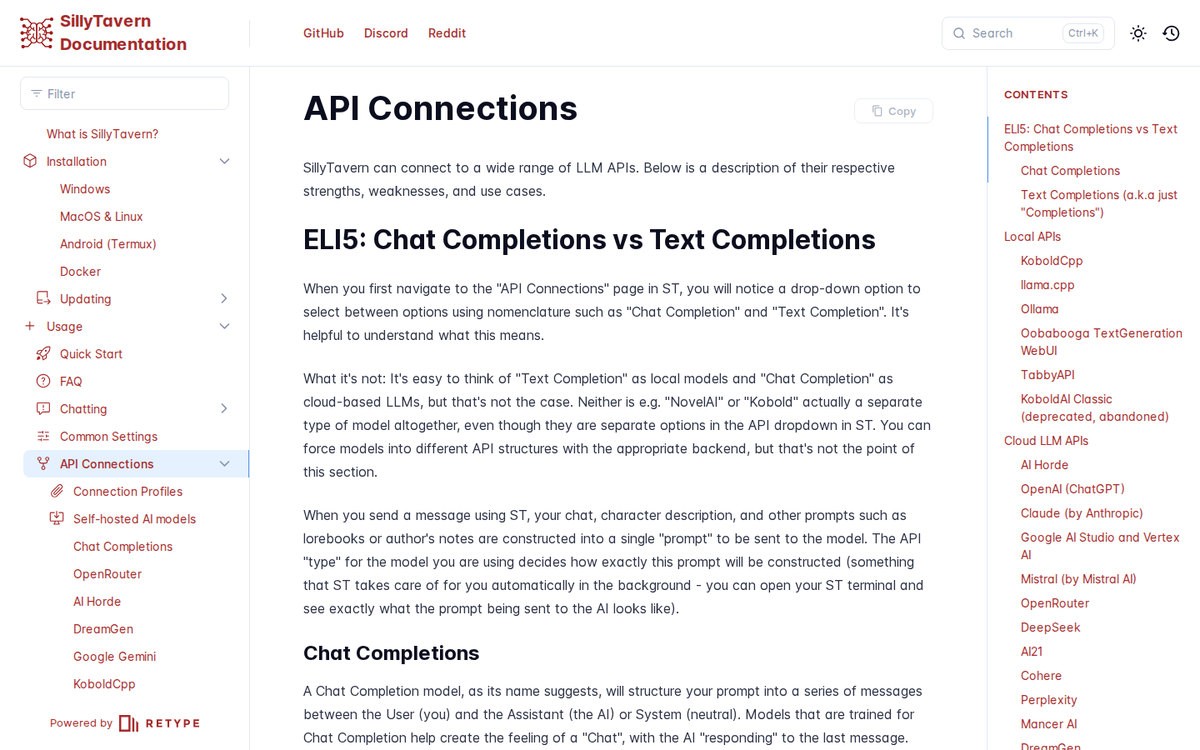
SillyTavern’s documentation page listing the local and cloud model back ends it connects to, September 2026.
For this angle nothing beats it. You can run the same Euryale 70B or DeepSeek V3 that SpicyChat keeps on its top tier, read the model card first, and know exactly how many tokens of context you have because you typed the number.
What it costs. The software is free. A local model costs nothing per message if you own the hardware; API providers bill per token, so it is either the cheapest or the most expensive option in our directory depending on the model.
The catch. It is sixth, not first, because it is software rather than a companion service. There is no account, no hosted characters, no mobile app and no support desk. Installation and configuration are on you, there is no moderation layer beyond your provider’s rules, and a bad experience is usually a settings problem you have to diagnose yourself.
Who it is for. Technical users who treat model choice as the point. Radar score 7.6.
Also considered
Character.AI (Radar score 6.8): names chat styles (PipSqueak 2, DeepSqueak, LongSqueak with “4x the Memory”) and its own AvatarFX video model, and a November 2025 research post says the team is now building on open-source models. It never maps a style to a base model and publishes no context figure.
CrushOn AI (Radar score 4.6): reviewers describe a selector with vendor names in the labels (DeepSeek, GLM, Gemini, Kimi, Claude) and a context figure per model. It would rank here if we could read it first-hand, but crushon.ai blocks our fetcher and we found no official model list.
Chub AI (Radar score 6.4): hosted models including the in-house Soji, plus bring-your-own-key. Similar in spirit to Janitor AI, with less published about the house model.
Chai (Radar score 4.2): publishes a timeline of model sizes, from 6B in 2023 to a 235B-A22B Mixture-of-Experts in December 2025, and its training methods, but not what the models are called or built on.
Who says nothing
Candy AI (Radar score 8.0) names no chat, image, video or voice model. The only public label is “V2” for its newer character engine, and its parent company describes a moderation layer, EverGuard, rather than a model. Replika (Radar score 5.9) says only that it “combines our own and third party Large Language Models and scripted dialogue content”; its Ultra and Platinum tiers promise smarter replies without saying why. OurDream AI (Radar score 7.8) names tiers (Balanced, Lively, Genius, Lively Genius) and prices them in coins, but not vendors; the widely repeated claim that it runs on DeepSeek-V3 comes from reviewers, not the company. Silence is not proof of a weak model: Candy and OurDream both score well with us. It does mean you are buying on trust, and that a model can be swapped without anyone telling you.
Questions people ask
Why does it matter which model an AI companion runs?
Model size and context size are the two best predictors of how coherent a long roleplay will be, and the model is the main running cost the app passes on to you. A named model can be checked against public model cards and benchmarks; “advanced AI” cannot.
Which AI companion apps use DeepSeek?
SpicyChat lists DeepSeek V3 on its I’m All In tier. Janitor AI offers DeepSeek through the janitor+ Router or your own API key, and SillyTavern connects to it directly. Claims that other apps run on DeepSeek are third-party and unconfirmed.
What model does Character.AI use?
It does not say. It exposes chat styles such as PipSqueak 2, DeepSqueak and LongSqueak, and has stated that it now builds on open-source models, but no style is mapped to a named base model or a context size.
What LLM does Candy AI use?
Undisclosed. Candy AI’s site and help centre name no language, image, video or voice model. Reviewer suggestions of a proprietary fine-tune or an ElevenLabs voice are guesses that Candy has not confirmed.
What is JLLM on Janitor AI?
JLLM is Janitor AI’s own free default model. Its changelog records a new base architecture on 20 April 2026, “heavily tuned with high quality gemini and opus data”, but does not name that architecture. janitor+ ($12.99 a month) gives it five times the context.
How much memory does Kindroid have?
About 500K characters of total conversation context on Standard, 1.3M with Ultra and 2.8M with MAX, of which roughly 18K, 50K and 125K characters are verbatim short-term context. See our memory ranking for how that compares.
Apps in this article

MyBabes
Multi-feature
8.3
The broadest creative toolkit in the category: eight named video engines with published per-second prices, two image model lines, a story studio, AI-refereed roleplay games and a creator paywall. Browser only, no voice calls, and the token maths take a minute.
Images
Video
Voice
Memory
From €9.99/mo (3-month plan)
Editor’s pick

Candy AI
Multi-feature
8.0
The most complete media stack in the category, chat, voice, images, 120-second Live Action video and Story Mode, but the subscription is only the entry fee. Tokens for anything visual push real spend well past the headline price.
Images
Video
Voice
Memory
From About €3.99/mo (annual promo); €13.99 monthly; tokens extra
Editor’s pick

SillyTavern
Roleplay
7.6
The power user’s choice: free, open source and endlessly configurable, with the best memory tools in the directory. You supply the model, the hosting and the patience, and your bill runs from nothing to over $100 a month.
Images
Voice
Memory
From Free (model costs from $0 local to roughly $2–$110 a month via APIs)

Kindroid
Multi-feature
7.4
The most transparent power-user companion: published memory limits, a new Polaris model, explicit content for verified adults. The free tier ends on 1 October 2026; expect a stacked bill and credit meters.
Images
Video
Voice
Memory
From $13.99/month on the web ($11.67/month billed yearly); free preview of 50 interactions only
Editor’s pick

Nomi AI
Multi-feature
6.9
The strongest memory in mainstream companion apps, with expressive voice included, held back by suggestive-only images, a no-refund policy and pricing you only see after signing up.
Images
Video
Voice
Memory
From $15.99/month ($8.33/month billed yearly); free tier available

Character.AI
Roleplay
6.8
The biggest character catalogue around, now with a $4.99 Lite tier below c.ai+. Strict no-pornography rule, ads and paid Charms on the free tier, a heavy legal history, and a chief executive leaving for Disney.
Images
Video
Voice
Memory
From Free; Lite $4.99/month; c.ai+ $9.99/month or $94.99/year

Janitor AI
Roleplay
6.7
The largest free character-chat community, and genuinely free: text only, no images, no video. Memory on the house model is short, and quality dipped in 2026. Janitor+ and the Router fix that for a fee; a proxy fixes it for less.
From Free; Janitor+ $12.99/mo; Router credits metered on top

SpicyChat
Roleplay
6.6
An uncensored, community-driven roleplay platform with a genuinely usable free tier, transparent pricing and a strong model line-up. Short replies, small context on cheaper tiers, no iOS app and regional age checks are the trade-offs.
Images
Voice
Memory
From Free; Get A Taste $5.95/month or $60/year (from 8 September 2026)
More from Radar
Xotic AI pricing: XOT tokens, the €24.99 plan and real media costs
Xotic AI’s Ultimate plan is €24.99 a month with 1,000 XOT; images cost 50 XOT, clips 150 to 500, calls 50 a minute, and every payment is final. Worked monthly bills and the refund wording.
Talkie+ explained: price, what it unlocks and whether it is worth it
Talkie+ is $9.99 a month or $49.99 for the first year on the App Store, with Pro at $24.99. It removes ads and the 50-message wall. Here is what it unlocks and how it compares with c.ai+.
Is Nomi AI safe? Privacy, age checks, memory data and what to expect
Nomi AI has a named US operator, no known breach and self-serve deletion, but a vague training clause, no refunds and age checks verified only in Australia and Kansas.
Kindroid models explained: Polaris, Ember, Reverie and the tiers
Pick Polaris on Speedy with the Companion flair. Kindroid’s model line from Rhapsody V6 to Polaris, the reasoning slider, context per tier, Lite’s retirement and what Ultra and MAX add.
How to cancel CrushOn AI: subscription, refunds, account deletion
Cancel CrushOn AI on the web under Profile → My Subscription → Manage → Cancel Subscription. Access runs to the end of the cycle, and the terms rule out refunds.
How to cancel Nomi AI: subscription, refunds and account deletion
Cancel Nomi AI where you bought it: on the web via Profile → Subscription → Manage Subscription, or in the App Store or Google Play. Payments are non-refundable.
How to cancel Character.AI: c.ai+, refunds and account deletion
Cancel c.ai+ where you bought it: App Store, Google Play, or Settings → Account → Manage on the web. The plan runs to the end of the period; no partial refunds.
Refund policies of 43 AI companion apps, compared
22 apps give no refunds, 8 give a short window, 6 decide case by case. The exact refund wording and what happens to your credits, for every app in the directory.
5 dark horses: underrated AI companion apps in 2026
MyBabes, Kindroid, SillyTavern, Seduced AI and Lovescape score near the top of Radar’s directory with a fraction of the big brands’ fame. Here is why, and the catch with each.